Wednesday, October 16, 2013

Pregnant Onion

The Pregnant Onion, Albuca bracteata {formerly known as Ornithogalum caudatum, the botanical name was changed in 2009} is a South African plant grown primarily for its unusual method of reproducing.
 
This is another of those plants that I remember from my childhood. It inhabited many front porches in the small town I grew up in, sometimes growing in cracked clay pots, but more often than not, thriving in a half rusted coffee can, rubbing shoulders with a monstrous aloe that was overflowing a chipped and leaking enamel kettle. 
 
These plants were 'pass-a-longs,' usually being passed from neighbor to neighbor over the back yard fence.  If they were purchased, the transaction took place in the church basement at the Autumn Bazaar, where you bought a tiny, barely rooted 'start' crowded into a Dixie cup filled with soil from the vegetable garden for twenty-five cents.
 
 
It's also one of those plants that are kind of difficult to explain.  While it's not particularly attractive, it is none-the-less treasured by many. 
 
In the photo below, if you look closely, you can see the reason for its common name of 'Pregnant Onion'.  Just below the surface of the skin, you can see the oval outlines of offsets.  Soon, the outer layer of skin will dry, turn brown then split open, revealing...
 
 
 small plantlets.  (while many people leave the brown skin on the plant, I'm a meticulous plant groomer, and I remove it for a couple of reasons... first, I don't like the looks of the dead and peeling skin, and secondly, when I remove the brown papery skin I can observe the new 'babies' growing under the green skin.)
 
 
The babies in the previous photo are of a size to be removed if you wish... they detach with a slight touch, and will quickly root if placed in soil.  Or you can leave them where they are.  Eventually, they'll get large enough to come off on their own and root where they fall. 
 
Culture of the plants is fairly easy... even though they are considered a succulent, they actually do better if they're treated more like a tropical.  Plant them in a good potting soil with sand, perlite or vermiculite mixed in, water them when the top inch of soil gets dry, and place them on a bright patio or in the brightest window you have.   
 
If the bulb begins to wrinkle up or go soft, it needs more water than you're giving it... but don't panic.  It does store water in it's bulb, and there are reports of plants surviving after they've been unwatered for six months.  The plants may look totally dead, but there's a very good chance it will begin growing as soon as they've received a good drink.  This is an adaptation to its native habitat in South Africa, where it often goes dormant during the long and intensely hot dry season. 
 
If the plants have a good potting soil, they don't require much in the way of fertilizer, maybe about 1/4 of the recommended strength about once a month. 
 
They do have a few other interesting, possibly annoying, quirks.  The leaves naturally arch out and down, and where they touch the soil, tabletop, etc, the leaf tips promptly turn brown and die, leaving the rest of the leaf green and intact. This habit has prompted many people to grow them either elevated on stands, or in hanging baskets, where the straplike leaves may hang down two or three feet, and they can look pretty striking, especially if there are three to five of the bulbs planted in the pot to really fill it out. 
 
In it's native country, the plant is considered an aphrodisiac, no doubt the appearance of pregnancy giving it a fertility aspect in sympathetic magic cultures. 
 
It was also commonly used much like Aloe barbarensis (Aloe vera) to treat minor skin complaints throughout much of Europe, but I don't recommend it, as the sap has been known to cause rashes and all parts of the plant are considered toxic.  Under no circumstances should you mistake this for a real onion.  Please don't eat it.
 
If you're  lucky, the plant likes you,  and you'll witness it's one true claim to beauty.  You may have noticed in the first picture, but here's a close-up...
 
They do bloom, and rather dramatically.  Mine is just beginning to grow a bloom stalk, but eventually, that stalk may grow to 3 to 6 feet, and begin putting out dozens of 1-inch wide green and white flowers...  The plants may bloom at any time of year, and may bloom more or less continuously.  The key seems to be enough water, and enough light. They rarely bloom for me during the hot summer months, which isn't surprising,  as I mentioned before, in habitat, they tend to go dormant in the heat of summer, and even though I manage to keep them green and growing all year I can't really expect to fight back generations of evolution.  Gardeners in milder climates than mine can keep them blooming all summer, and I suspect that they would be more likely to bloom here if they were planted in the ground rather than confined to a pot. 
 
They are reported to make good border plants if they're grown in the garden, especially if several of the bulbs are clumped together. Cultivated in this manner, the strap-like leaves look reminiscent of a crinum lily, and the tall bloom stems can make a nice display when they're blooming all at once.   If you want to try it, just be careful to not bury the bulb as it may rot if you do.
 
The flowers, when grown outside and exposed to pollinators, will produce seeds which will scatter and sprout, but they are easily uprooted and shared with friends, or discarded. 
 
In zone 9 and further south, a hard frost will kill the leaves, but the bulb will quickly regrow.  Further north, it's simple to take in a few bulbs, offsets or seedlings and pot them up as a houseplant over the winter, or bulbs can be allowed to dry and go dormant till they can be replanted next spring. 
 
They also won't bloom until the bulb reaches about 3 inches in diameter, but this one reached that size in the space of one year.  The maximum size you can really expect from the bulb is 5 inches, but the plant will take it's time getting there.
 
When the blooms open, I'll be sure to post an update.

Mushrooms again...

 Well, it's mushroom  season in Texas... cold autumn rains followed by warm autumn days result in rather fantastic displays in the lawns...
 
         While some people hate the toadstools, mushrooms, and fairy rings in the yard, and will immediately run outside with plastic bags and gardening gloves to restore their lawn to golf course smoothness... I like the things.  I think of them as free garden ornaments.  They're also a sign of  
 
        I've identified the species, to the best of my ability... I've never been confident of my ID of mushrooms.  Which is why I've never been tempted to harvest wild mushrooms for dinner... there's always the chance that I'll kill myself and everyone else... except of course for Morel mushrooms, nothing else looks like a morel mushroom, but I haven't run across any of them for years. 
 
        Anyway, click on the name  under the pic, and it's a link to the Mushroom Experts truly excellent site.


And speaking of truly excellent sites... there's a new blog in the blog roll... called Eat The Weeds... The acorns are starting to fall, and I'd heard of Acorn Flour, but I'd never had any experience with it, so I did a little web search and ran across that truly excellent and extremely informative blog. I highly recommend you check it out. 
 
As for acorn flour... here's the post and it sounds like a real pain in the ole patootie, so I probably won't bother, but nice t know I can make it if I have to... 


Wednesday, October 09, 2013

Shopping bags...

With more and more municipalities banning or limiting the plastic shopping bag, for various reasons, those canvas totes are becoming necessities.  But they're not really convenient.  Unless you have a couple of dozen of the things taking up room in the back seat of the car,  spontaneous trips to the store become difficult.  And, eventually, it wears out, the sides split, the handle becomes detached... nothing insurmountable, but there we are.
And I just don't like the things...  if you can find some that don't have idiot advertising on the side, you have to pay for them.  And no matter how you fold them, hang them, our try to store them, they take too much room.
Carrying stuff shouldn't require all this thought... then I remembered Moll Flanders.
It's an excellent book, a story of an English  orphan turned pickpocket, turned prostitute turned respectable American immigrant.  I highly recommend it.
But the point is, in that book, at various points in the story, she whips off her shawl and uses it to bundle up baggage, children, stolen goods, etc.  Throughout much old literature, women used shawls, scarves, aprons, tablecloths, etc in this manner.
Now, I'm not recommending that anybody show up at their local piggly wiggly with an old sheet to carry their groceries.  Well, not exactly.
Let's start with this...
 
Get about a yard of rope.  This is standard jute rope.  You can use any kind of rope you got laying around. 
fold it into two figure 8's, with the ends of the rope in the middle.
 
 
a tiny piece of duct tape holds everything in place...
 
Then more duct tape around it... two layers, as tight as you can wrap it. 
 
Now, I happen to have this giant roll of bias strip that I bought for $2.00 at a rummage sale... but any strip of fabric you got will work.  Consider strips of an old sheet, or a t-shirt, or anything.  I've made several of these, and I've used about everything, and it all works fine. 
 
place it through one of the loops, fold it back and start wrapping around.


when you get to the other end, cut off your strip from the roll,  leaving 6 to 12 inches.  Put it through  either one or both of the loops, and then through the loop  of fabric, pull it  tight and wrap it down. 


secure the end with a few quick stitches... no need to be fancy...
 
 
Then, find a big scarf.  This isn't difficult around here... the normal bandana doesn't fit on my head, I have a large hat size, so I have a couple of dozen head scarves made from random cotton fabric remnants.  They come in handy when I'm mowing the lawn or I haven't washed my hair... Most are plaid or skeleton prints, but for this I used the solid red so that you could see what was going on...
 
pull a corner through each loop, and tie in a knot. 


repeat on both ends of your handle, and you have a bag. 


Actually, you'd be amazed at how much these things will hold... and as to the scarves... you get 1 1/2 yards of any fabric, trim it to a perfect square and give it a tiny shirt-tail hem, and you've got a 40 inch square scarf.  But you don't have to buy fabric... sheets that are faded, have frayed hems or you just don't like anymore are made from very durable fabric.  A sheet will give you a minimum of 4 scarves.  And I'm sure you can think of other things to recycle...
 
You can  store at least three of these handles and three or more of these scarves in your glove-box, and I defy you to cram even one of those canvas totes in there.  Plus, these wash easily... a cavas tote can be washed, but comes out wrinkled, crumpled and misshapen, and is never really right again. 
 
Anyway, this is what works for me.  If you have any other ideas, I'd like to hear them...


Sunday, October 06, 2013

We've done been occupied


The Occupy the Cemetary/Zombie rights 
movement has staged a sit-in at the flea market to protest the negative stereotype being perpetuated by the haunted house on our property.  It was an overwhelmingly peaceful demonstration...


And then the riot police showed up ...

Thursday, October 03, 2013

I couldn't help myself.

This showed up on my email.  I have no idea where it's from, or who took it. 

I like it.

Wednesday, October 02, 2013

well, I'm trying not to be so scattered but there we are.  Later today, I'll be  updating new pics on the little goth bob site... I got sidetracked by the flea market.   Here's what happened. 

Someone at the flea had something that they wanted to sell for $60 bucks, but we don't really have the customer base for it out there.  So I said, put it on Craigslist.  Well, she doesn't have a computer, and the only cell phone is one of those primitive ones that make phone calls and that's it... (How third world) 

So I listed it for her, and it sold for $150.  I considered it my good deed for the month... no big deal. 

But she insisted on giving me $50 for it, (after all, she'd only wanted 60) and said she had some comparable things to sell, and anything over $100 I could have...

Of course, other dealers out there came to me to sell on craigslist immediately, because you'd be amazed at how many people are intimidated by that site.  Really, you're reading a blog, so you're obviously a little computer comfortable at least, but there are people out there that plain flat out shake in their boots when confronted with a keyboard... and many of them seem to be living fairly rural and dealing in flea markets, and I have been declared the flea market computer wizard, which is really amazing since I don't know even the most rudimentary html code, so all that's been taking some time...

And in the process, I've also been listing on some of the Facebook groups.  They have all these groups that are for buying, selling, trading, or just plain flat out giving away stuff.  They're a good source of items for me, and a good outlet for selling things for me.  They also swallow up time. 

And right now, as I type, I should be mowing a nearly 1 acre lawn.  And after that... I'll take pics of little bobs and get them posted. 

Sounds like a plan.  We'll see how it works out... 


Tuesday, October 01, 2013

Opuntia microdasys

Opuntia microdasys, and the varieties of the species, are common houseplants, often encountered in dish gardens or in small pots at big box stores. 
 
Fortunately, O. microdasys is attractive and tends to be of a size that it can be impressive without being troublesome, it's maximum size is three feet tall and wide, but in pot culture, you can expect about half that.  It is therefore common as a houseplant, and for some collectors, (who let's face it, can be pretty picky about what plants they're willing to have around) this may be the only prickly pear allowed to rub shoulders with their much rarer specimens. 
 
 
This native of Mexico is heavily covered with glochids, which are the small hair-like spines that are the calling card of prickly pears, and, like a few other species of opuntia, do not have the longer needle like spines of most cacti. 
 
There are four variations of the species that you may encounter... This, with its yellow glochids, is the standard or main species, and may produce yellow blooms. 
 
Opuntia microdasys v. rufida  has glochids that are a cinnamon, reddish brown color, and is sometime called the Teddy Bear cactus. 
 
Opuntia microdasys v. albispina  has glochids that are white, and is sometimes called Bunny Ears. 
 
The other variety of the species is a mutation often referred to as Golden Ruffles,  where each pad of growth grows ruffled edges, and is properly named O. microdasys v. crestata. 
 
Despite the cute common names, don't feel tempted to give them a cuddle.  Glochids are not something that you want to deal with on an up close and personal level.  They're not exactly painful, but they can be maddeningly irritating.  Duct tape pressed against the skin to yank them out is usually the easiest way to deal with them.  To be blunt... I'd rather deal with spines, but there we are. 
 
I've grown all varieties over the years, and the care is more or less identical.  They can take all the sun you can give them.  They appreciate watering about once a week in the heat of summer, but can take less if they have to... if they start looking limp or shriveled, you may need to water them a bit more... potted plants tend to need more water than specimens in the ground.  
 
Currently, I only grow the yellow standard because it's the only variety that is really  winter hardy in my climate.  Here, in the Dallas/Fort Worth area on the line between zone 7 and 8, this plant will survive the winter outside provided it's in a pot, rock garden, or in a part of the yard that doesn't collect water.  The key to almost any cactus surviving a cold winter outside is drainage. 
 
This species can take cold.  But they cannot take cold and wet.  
 
During hard winters, I may lose some of the plant, but there's usually enough to recover so that by late spring it's looking impressive.  However, I don't get blooms off of the outside plants, so I'm probably really pushing it's cold tolerance. 
 
The other forms, do not tolerate cold, and must be moved inside for the winter.  Placed in the brightest window possible, and watered very little, they will usually overwinter fine.   


Besides the cold issue... any good cactus soil, or even any potting soil with lots of perlite and sand mixed in will suit it fine.  The plants are pretty heavy feeders, and if they're given fresh soil every spring, they quickly show their gratitude with lots of new growth.  Feed them every other watering with about half recommended strength plant food, they'll be happy. While they're heavy feeders, too much food results in growth that is too lush and too soft to stand up for long, especially to cold... I usually stop feeding the plants in September to help them tough up for the coming winter. 
 
Like all prickly pears, propogation is simple from cuttings.  Actually, the cuttings root so easily, that Opuntia will often propogate themselves without any help from  you.  It's not uncommon to find a pad that has broken off, rooting and growing under the parent... but to do it intentionally... break or cut off a pad, let it sit somewhere for a week or two so that the cut edge will dry out, then pot up the pad in soil.  Within a month it'll be rooted and growing.  If you really want to increase the amount of plants you have, you can actually cut each pad in to four pieces, once from top to bottom and then cut those two pieces in half across.  After the cuts have dried, those four pieces will, when planted, each grow roots and pads.  I once knew someone who would line a black plastic nursery tray with canvas, fill it with potting soil, and place about fifty of these cuttings of cuttings in there.  Each would grow and within 2 months he had plants to pot up and sell in another month.
 
Personally, as an experiment, I once rooted six pads, two of each of the three color varieties, in a hanging basket.  It was interesting looking on the patio, and, with hindsight, it was  such a relief to have a hanging basket that didn't need watered twice a day, that I kind of wonder why I didn't do it again...


Monday, September 30, 2013

Weekends are busy...

By here's a few pics I managed to take at the flea...


Morning glories growing on the fence.   These are the wild varieties that bloom this type of year after the fall rains start. 


A six foot tall iron bird cage.... if you don't have a bird, they're great for displaying plants.  Orchids look great, or bromiliads.  Its.asking price is 150.00.

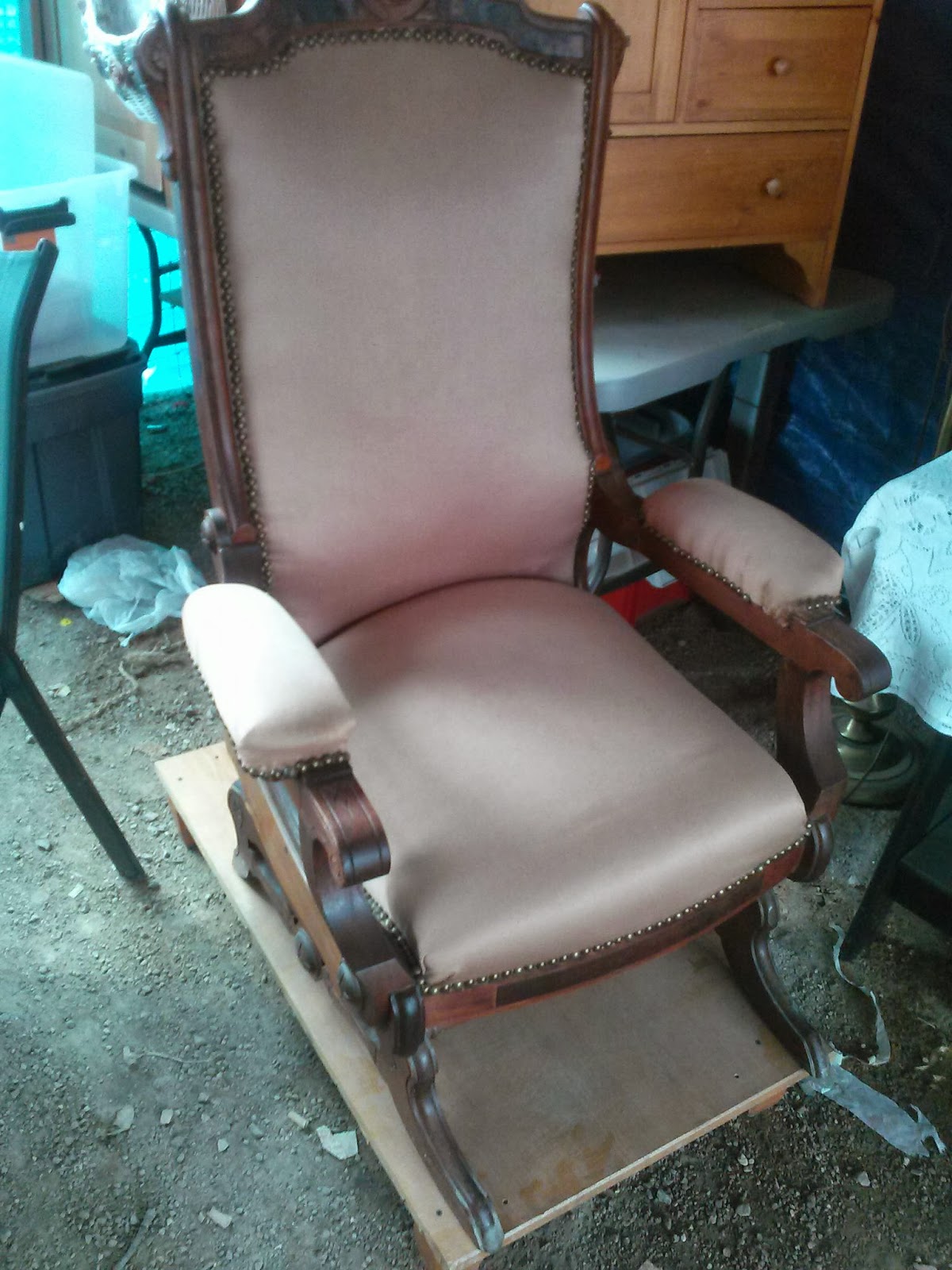
A teak Victorian rocker... priced at $175.00, but we could talk her down a little. 

And just for fun...

The soundtrack to Valley Of The Dolls. A hipster must have... for a dollar...

Thursday, September 26, 2013

Consolea

Once upon a time, almost every cactus you see was called a Cereus.  This is generally how plant classification works... It starts very simply.  Water holding desert plants with viscious spines are obviously different from all the other plants, so lets call them the same thing. 

Then, well this spiny plant was obviously a different kind of spiny plant than that one, so you begin sorting them out, and you eventually separate things into groups of genus's of their own, and so on and so forth.  Some of these splits are fairly straightforward... The Giant Saguaro started Cereus giganteus, went to Pilocereus giganteus, and eventually settled into Carnegiea gigantea.  And it's fairly obvious that, say, a Mammillaria is not a Carnegiea.  And some of those Mammillaria are obviously and noticeably different from the others, let's call them Escobaria... etc.

Then science makes an advance, people look at things under their magnifying glasses... then their microscopes, then electron microscopes, then genetic testing comes into play.  All this in the interest of accuracy and making plants easier to ID and actually making it nearly impossible for the average Joe, who let's face it can't reasonably be expected to have an electron microscope laying around gathering dust in the garage, to ID that really cool plant he just bought of the clearance table at Wal-Mart with 100% certainty on his own, so he's relying on the tag stuck to the side of the pot which may or may not be right, because the nursery where the plant came from doesn't have an electron microscope either. 

Let's face it folks... you need a masters degree to understand the language in some of those scientific papers, much less the actual science involved. 

Well, the work separating those cereus types is ongoing, and as more advances happen, will continue.  And some of those diligent little scientists have turned their attention to Opuntia. 

At first, Opuntia seems a fairly straight-forward genus.  Most of them grow in pads or sections.  Most have spines, and at the base of the spine, in the ariole, there are little mini-spines called glochids which are much more troublesome than the spines ever hoped to be.  These are collectively called Prickly Pears.  Some of them are called Cholla.  Most of us can wrap our brains around this pretty easily.

Turns out, not quite as straightforward as we thought.  While, most Opuntia are still Opuntia... it is being split into several genera.  Currently, according to Wikipedia, fifteen genera.  I fully expect more to come... Under the subfamily Opuntioideae, we have:

1.  Austrocylindropuntia (cholla-ish)
2.  Cumulopuntia (cholla-ish.  Actually, even more "ish")
3.  Cylindropuntieae (cholla)
4.  Grusonia (cholla)
5.  Pereskiopsis (most of us wouldn't recognize Pereskiopsis as a prickly pear, or even a cactus)
6.  Quiabentia (another that doesn't even look like a cactus.)
7.  Brasiliopuntia (prickly pear.  A really tall one.  You've probably seen little ones as house plants)
8.  Consolea (prickly pear.)
9.  Milqueliopuntia (stubby cholla)
10.Opuntia (prickly pear)
11.Tacinga (prickly pear)
12. Tunilla (pickly pear)
13. Pterocactus (cholla-ish)
14. Maihueniopsis (prickly pear-ish)
15.Tephrocactus (cholla-ish)

Some sources also list a few others... notable Micropuntia (little chollas) but until everybody straightens themselves out, we're gonna go with what we got. 

Now, all this is complicated by the fact that prickly pears are, as a general rule, highly adaptable and highly variable.  Hence, the plant in the natural habitat, and the plant you have at home may be the same species, but look totally different,  The amount of light, water etc, will all make the plant change it's size, spines, even color.  So it's confusing enough. 

And now, we get to the plant that started all this... It started when a friend of mine bought a prickly pear on the clearance table at Wal-Mart. 

Actually, it was a score.  A really nice one gallon pot full of bright green pads, for five bucks.  I was a little jealous. 

"Where are you gonna put it?" I asked, looking around to the living room windows. 

"In the yard," he answered. 

"You mean on the patio?"

"No.  Out by the garage with that other prickly pear."

"It'll  die!  It won't survive the winter."

"Hell they grow wild in the pasture..."

"Not this kind.  Most prickly pears won't..."

Blank stare.

"It's a damn prickly pear..."

"There are like, a hundred different kinds of prickly pears... and most get killed by a hard frost..."

"Whatever..."  followed by eye-roll. 

So, you're starting to get the idea of why it's kind of important to find out what kind of prickly pear you got...
Anyway, I looked on the side of the pot, and saw the name Opuntia falcate.  I whipped out the smart phone, typed it in and... Nothing. 
 
So, I took a couple of small juvenile pads, and promised to get back... In case you haven't noticed, cuttings off plants I have to ID is turning into a very convenient way to increase my collection with no investment of money.  Just saying.

They're rooting now... actually, they're very well rooted now and starting to show the first signs of growing.
 
 
And here's what I found out... Yes it's a prickly pear.  Obviously.  And no, it's not an Opuntia.   It's a Consolea falcata.  Or possibly a Consolea macracantha... no way of telling till it gets a few blooms on it, which is probably a while off.  Native to the Caribbean islands, it is listed as critically endangered in Haiti, and may not be there anymore.  (there were 10 mature plants on a beach in Haiti before the 2008 hurricane, which may or may not have wiped them out.  So, if anybody is going to Haiti, you're probably going to hit a beach at some point, so it might as well be this beach, so look around, see if there's any cactus and let us know.) 
 
It seems to produce rather smaller 'juvenile' pads, and look pretty cute, before it puts up longer, round straight growth which grows pads on the end.  The juvenile pads then, over a period of time, waste away.  All of this is pretty far off, but I am sure that it won't survive a winter here, which was really the point, and I won the bet, (FREE PIZZA, WOOOO HOOOO) and got a new plant in the process so I'm doing good...  
 
Since it's native to Haiti, I'm going to assume that, even though it grows in sandy soil near the beach, it still needs a bit more water than our native prickly pears, and I'll water it whenever it gets dry. 
 
Next, and totally unrelated, I was over at Julies blog, A Succulent Life, where she was thrilled to find a grasshopper.  While I certainly can't imagine being happy about that, I did promise to take pictures of one of the more handsome species that frequent the yard here if I got a chance.  Well, when I went out to take a pic of the little prickly pear here, lo and behold, look who was sitting on my Rhipsalis cuttings.  Got a pic before I made him leave... Enjoy Julie...
 
Update... this grasshopper has been ID'd as Schistocerca obscura, commonly known as the Obscure Bird Grasshopper.  I don't know why its called obscure, but there we are...
 

Wednesday, September 25, 2013

blogger public service announcement...

hey folks... I'm sure some of you know about this already... but if you go to your stats page and see multiple views from places with weird names... like  'vampirestat,' 'adsensewatchdog' 'zombiestat' 'uglystat' etc... there's too many to actually list here, and there's new ones everyday.  Don't click on the links. 

At best, you'll be directed to a page of ads.  At worst, you'll be infected with malware or a rather nasty virus. 

The new blog, Little Goth Bob's World yesterday got 100+ views from these... in the future I shall call them BLOTIA which stands for Bloodsucking Leaches On The Internets Ass, but I fortunately already knew about them so I didn't click. 

They're called Referer Spam, and Google and/or Blogger is unable or unwilling to block them for some reason, and even if they did the name would change and they'd be back in the space of 15 minutes.  Even though it messes with your counts on the Stat Page, they are able to exclude the numbers when it comes to your AdSense page and Google ratings, so it doesn't affect that if your worried about it. 

If you really need to check or track your stats, there are a few widgets out there to do it.  They have no problem blocking these sites... hmmmm.  

Now, while I kinda understand what they are... here's a link that explains it a lot better than I can...

Spam Spoiler, a blogger on BlogSpot who knows his stuff.

The basic advice is this.  Don't click on them.  Ther're not actually reading your page, they're not actually going to your blog, they're not actually sending anyone to your blog.  As to the stats... it's an annoyance, but it's not harming you, and since it doesn't touch your adsense or google ratings, it's not costing you anything.  (which is probably why google isn't pursuing it) and unless you click the link, it doesn't really have anyway to get you. 

It's annoying, because I like to see if anyone is viewing my posts.  These numbers are confusing and they generally make the stat page totally useless. 

As a general rule... don't click on any of the links on the stat page.  If you really want to get on my blog, or anyone elses, do it from your link list, your followers list, or favorites list. 

announcement over.